


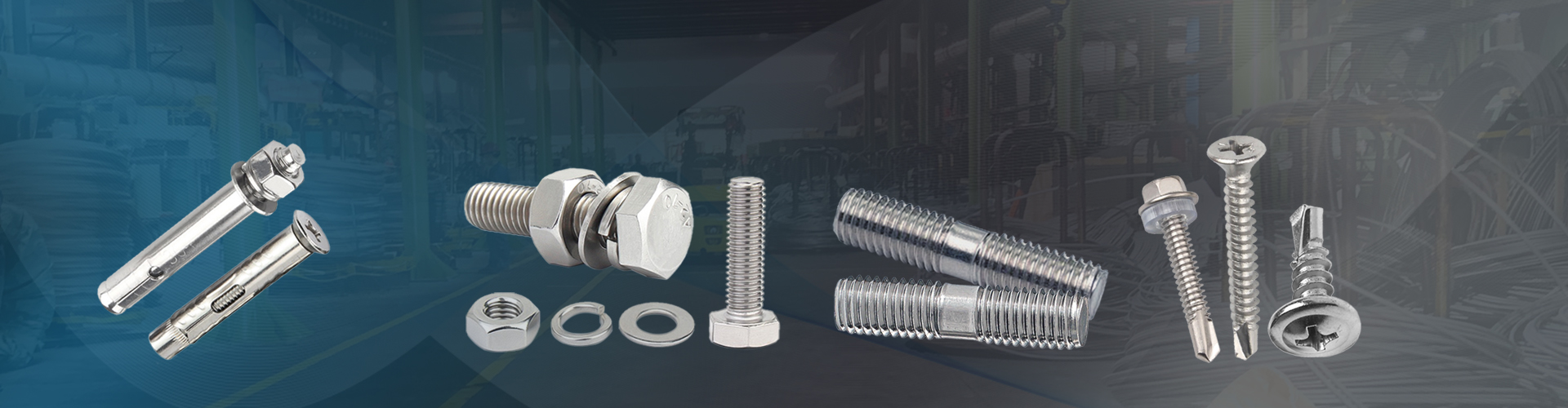


Stainless Steel Self Drilling Screws Compared: 304 vs 316, Self-Drilling vs Self-Tapping, and Head Types
A stainless steel self drilling screw drills the hole, forms the thread and fastens in one driving motion, while a self-tapping screw needs a pilot hole first. Choose A2/304 for inland and dry service, A4/316 or 316L where chlorides are present, and match drill point length to the total thickness being drilled rather than to the screw diameter. Head and washer geometry controls watertightness more than alloy grade does.
Stainless steel self drilling screws combine a fluted drill point with a tapping thread, so one tooling pass cuts the hole, rolls the mating thread and clamps the panel. Specifying them well means reconciling four variables that are normally quoted separately: alloy grade, drill point length against the total sheet stack, head-and-washer geometry, and the standard written on the drawing. This comparison sets those four against each other, then closes with the checks AOZHAN applies before a batch leaves the factory.
Quick Takeaways
- Self-drilling (Tek-type) screws carry a fluted drill point; self-tapping screws carry a blunt or tapered point and require a pilot hole.
- Grade follows exposure, not preference: 304/A2 inland, 316/A4 coastal and de-icing zones, 316L for welded or heavy sections, 2205 duplex for severe chloride combined with higher load.
- Drill point length must clear the whole stack — sheet plus purlin, or both layers of a lap joint — or the screw will spin without penetrating.
- Hex washer head with a bonded EPDM washer is the default watertight roofing detail; countersunk heads belong to flush facade work.
- Stainless-on-stainless galling and stainless-to-aluminium galvanic coupling are the two field failures that most specification sheets leave out.
- Release a batch only after thread gauge, point-length, washer peel, magnetic and salt-spray records are tied to the lot number.
What Are Stainless Steel Self Drilling Screws?

The format is a thread-forming fastener whose tip carries a small fluted drill, allowing a single tooling pass to cut the hole, roll the mating thread and clamp the panel. The format sits inside a wider family: Wikipedia's entry on the self-tapping screw separates thread-forming types, which displace material, from thread-cutting types, which remove it, and lists self-drilling screws as a distinct sub-type because their tip performs the drilling operation instead of relying on a prepared hole.
The commercial name changes by market. US contractors say Tek screw after the original brand; European drawings cite DIN 7504; Asian schedules often use "drilling screws with tapping screw thread". The trade also uses self-drilling tapping screw, sheet metal screw and roofing screw. All describe the same construction — a hardened point, a full-length thread and a head suited to the panel — which is why a request that names only a brand usually has to be translated back to a standard before it can be quoted or cross-checked.
Stainless versions exist for one reason: the fastener becomes the exposed, unpainted element of the assembly. On a coated steel roof, a zinc-plated screw is protected by the same galvanic principle as the sheet it holds. On an aluminium facade, a stainless rainscreen, a food-plant panel or a coastal solar array there is no coating to absorb the environment, so the screw body itself has to carry the corrosion duty. That is why stainless versions are specified most often where the fastener stays visible and wetted — facade panels, roofing edge zones, pool and washdown areas, and structures within a few kilometres of the coast.
Two physical limits follow from the construction and should be checked before any grade decision. The point must be long enough to drill the entire stack, and the head must present enough bearing area for the face material to avoid crushing it. Both are treated below, after the thread-type fork that decides whether a drill point is needed at all. For the wider family of sheet-metal fasteners that do require a prepared hole, AOZHAN's self-tapping screw range covers the blunt-point and thread-cutting versions that pair with these.
Self-Drilling vs Self-Tapping Screws: The Difference That Decides Your Assembly

Self drilling vs self tapping screws differ in one respect that changes the whole assembly sequence: who makes the hole. A self-drilling screw makes it, so the fastener is a one-operation tool. A self-tapping screw does not, so every fixing point needs a pilot hole at a diameter matched to the thread root before the screw is driven. That single difference propagates into labour, tooling, inspection and — most importantly — the failure mode when something is done wrong on site.
|
Decision point |
Self-drilling screw |
Self-tapping screw |
Machine screw |
|
Tip geometry |
Fluted drill point, designated #1 to #5 by length |
Blunt (type B) point, or tapered point for softer sheet |
Plain end, no point |
|
Pilot hole |
Not required |
Required, sized to the thread root |
Required, plus a tapped thread or nut |
|
Operations per fastener |
One: drill, thread and fasten together |
Two: drill, then drive |
One after the thread exists |
|
Typical substrate |
Steel 1–6 mm, timber-to-steel, layered assemblies |
Sheet 0.5–3 mm, plastics, thin sections |
Castings, nuts, threaded inserts |
|
Tooling |
Clutch driver set to a torque window; point quality decides life |
Drill plus driver, or a combination tool |
Driver only |
|
Failure if misapplied |
Burnt point, snapped shank, oversized hole that cannot be recovered |
Stripped thread in an undersized or oversized pilot |
Cross-threading, damaged thread |
|
When the assembly cannot be pre-drilled |
Standard choice |
Not viable |
Not viable |
The table also explains why the two products are not interchangeable on a drawing that leaves the method open. Replacing a self-drilling screw with a self-tapping screw on a roof deck does not merely add a drilling step; it moves the quality control point from the fastener supplier to the site crew, where pilot-hole diameter is rarely gauged. The reverse substitution removes a step but demands a point long enough for the full stack. Read that way, the self drilling vs self tapping screws decision is a decision about where quality control sits: with the supplier who controls point geometry, or with the site crew who controls pilot-hole diameter. AOZHAN keeps a dedicated comparison of self-tapping versus self-drilling screws for teams converting between the two.
Tek Drill Point Lengths: #1 to #5
Point length is the variable that most often turns a good specification into a site problem. The numbered designations describe how far the drill extends ahead of the thread: #1 is the shortest, intended for thin single sheet and for cases where the point must not break through into a cavity; #2 and #3 are the general-purpose lengths for steel-to-steel and sheet-to-purlin work; #4 and #5 are long points for layered assemblies, timber-to-steel and thick sections where the drill has to travel before the thread can engage.
The selection rule is arithmetic rather than visual. Add the thickness of every layer the point must pass before the first thread engages — face sheet, air gap closure, purlin flange, second panel — and add a margin for the point to establish full diameter before the thread bites. A point shorter than that total will spin, overheat and work-harden the sheet without cutting through. A point much longer than required leaves the drill exposed between panel and purlin, which is where bending and snapping start under off-axis driving.
When Pre-Drilling Still Applies
Self-drilling is not a universal substitute for a pilot hole. Pre-drilling remains the correct route when the substrate is harder than the point can cut, when the sheet is so thin that the point would break through before the thread engages, when the fastener is part of a structural or safety-critical connection that requires a declared hole tolerance, or when a countersunk head has to seat in a thin panel and a clean, burr-free seat is part of the finish. These screws are also poor at drilling stainless steel: the work-hardening of austenitic sheet can destroy a point in a few seconds. For stainless-to-stainless joints the standard practice is a pilot hole plus a self-tapping or machine screw, and a different grade pair to limit galling.
304 vs 316 Stainless Steel Screws: Grade Selection by Chloride Exposure
304 vs 316 stainless steel screws is the grade question that buyers ask first, and it is answered by exposure rather than by preference. Both are austenitic alloys built on a chromium passive film; the difference is molybdenum. Stainless steel gains its corrosion resistance from a chromium content of at least 10.5 percent, which forms a self-healing passive layer. Grade 304 supplies chromium and nickel without molybdenum and performs well in inland, atmospheric and mildly damp service. Grade 316 adds roughly 2 to 3 percent molybdenum, which raises resistance to chlorides and to pitting, and is the baseline for coastal, marine-splash and de-icing-salt environments.
|
Grade / designation |
UNS number |
ISO 3506-1 class |
Molybdenum |
Chloride performance |
Where it belongs |
|
304 / A2 |
S30400 |
A2-70 |
None |
Moderate; pitting possible in coastal air |
Indoor, inland facade, dry service, general sheet metal |
|
316 / A4 |
S31600 |
A4-70 |
2–3% |
Good; resists pitting and crevice attack |
Coastal, de-icing salt, food and washdown, marine splash |
|
316L / A4L |
S31603 |
A4-70 (low carbon) |
2–3% |
Good, with lower risk after welding |
Welded assemblies, heavy sections, cold-formed parts needing ductility |
|
2205 duplex |
S32205 |
Higher strength class |
3% plus nitrogen |
Very good; PREN around 35 |
Severe chloride with high load, industrial and offshore-adjacent |
|
Bi-metal |
Body per grade |
Per body |
Per body |
Body matches its grade; the point does not |
Drilling aluminium and mixed-metal stacks |
Property class matters as much as chemistry. A2-70 and A4-70 describe a minimum tensile strength of 700 MPa in ISO 3506-1, achieved by cold working rather than heat treatment. Because the strength comes from deformation, the same cold work makes austenitic screws slightly magnetic — a fact that confuses incoming inspectors who expect stainless to be non-magnetic. Magnetic response is therefore a process indicator, not a grade verdict, and should never be used alone to reject a lot. AOZHAN publishes a separate note on why stainless steel screws can be magnetic for procurement teams writing acceptance criteria.
Salt-spray evidence is the second half of the grade decision. Neutral salt spray to ASTM B117 is the usual screening test, and copper-accelerated acetic acid salt spray to ASTM B368 is the harsher decorative-automotive variant. A report is only meaningful when it states the grade, the surface condition, the test hours and whether the result is pass/fail on red rust or on white staining. AOZHAN's 3,000-hour salt spray record on 304 fasteners is useful context, but it describes 304 in that specific condition, not a licence to place 304 in a coastal facade.
Why Bi-Metal Screws Exist for Aluminium
Aluminium is soft, gummy and work-hardens quickly, which makes a stainless drill point skate and gall rather than cut. A bi-metal screw solves this by pairing a hardened carbon steel drill point with a stainless steel body: the point cuts aluminium cleanly, and the body keeps the corrosion resistance the application needs. The trade-off is that the point is not stainless, so it must be protected by the coating system, kept out of standing water and inspected after installation. For aluminium composite panels and mixed aluminium-to-steel stacks, bi-metal is usually the practical answer, with isolation washers added wherever the stainless body touches aluminium directly.
Inside AOZHAN's Stainless Line
At AOZHAN, stainless self-drilling screws begin as coil that is identified against the heat number and checked on an optical spectrometer before any heading tool is set; chromium, nickel and molybdenum are confirmed against the certificate rather than assumed from the wire tag. Cold heading forms head and shank in three blows, which keeps the grain flow continuous through the head fillet — the zone where field failures concentrate. The drill point is formed and ground, then gauged with a dedicated fixture that holds point length inside a narrow window; a long point is as much a reject as a short one, because it changes the engagement arithmetic the customer designed around.
Threads are rolled rather than cut, so the flanks carry uninterrupted grain flow and the root is compressed instead of weakened by a machined notch. Parts are then passivated to restore the passive film after grinding and to remove free iron picked up from tooling, rinsed in demineralised water and dried before packing. AOZHAN's production and inspection workflow records the spectrometer result, heading batch, point-length sample, thread gauge and salt-spray status against the lot, which is the evidence pack a facade contractor needs when the engineer of record asks how the screws were released.
Self Drilling Screw Head Types and Washers: Which Face Fits the Detail
Self drilling screw head types decide two things the alloy cannot: how the load spreads into the panel, and whether water can reach the substrate. The head is the only part of the fastener the building user ever sees, and it is also the part that fails first when the bearing area is too small for the face material. Five forms cover most stainless work, and the choice is driven by whether the detail can tolerate a protrusion and how fragile the face material is.
|
Head form |
Bearing area |
Countersink needed |
Typical application |
Washer options |
|
Hex washer head |
Large, integral flange |
No |
Roofing and cladding to purlins, general steel framing |
Integral flange; bonded EPDM available |
|
Pan head |
Medium, flat ring |
No |
Equipment cases, appliances, thin metal panels |
Usually none; sealing washer optional |
|
Countersunk (flat) |
Conical, seats flush |
Yes |
Facade panels and details where nothing may protrude |
None |
|
Truss / wafer |
Very large, shallow |
No |
Thin sheet, plastics, fragile laminates, where crushing is the risk |
None |
|
Round or oval |
Medium |
No |
Legacy and decorative work, replacement of existing stock |
None |
Bearing area is a pressure calculation in disguise. A pan head on a 0.5 mm aluminium composite panel concentrates the clamp load on a small annulus and can dimple the skin before the thread is fully engaged; a truss or wafer head spreads the same load over a wider ring and leaves the panel flat. A hex washer head on a purlin has the opposite duty: it must transfer wind uplift without deforming the flange, which is why the integral flange is larger than the thread diameter by design.
Bonded EPDM Washers and the Compression Rule
A bonded EPDM washer is the watertight detail, and its performance depends on compression rather than on thickness. The washer should be compressed to roughly a quarter to a third of its free thickness, enough to close the gap around the point and seal against the sheet, but not so far that the elastomer is permanently deformed or extruded. Driving until the metal flange touches the panel — the habit that "feels tight" — crushes the washer past its recovery range, and the joint leaks at the first thermal cycle. AOZHAN's note on EPDM washer self-tapping screws sets out the peel strength and compression checks used on bonded washers, and the general screw head types guide covers the geometry behind the table above.
DIN 7504 and ISO 15480 Self Drilling Screws: Standards Compared
DIN 7504 and ISO 15480 self drilling screws describe the same product family in two systems, and the part numbers do not map one-to-one by head form. DIN 7504 is divided by head: the K part covers the hexagon washer head, the N part the cross-recessed pan head, and the P part the cross-recessed countersunk head. The ISO series separates the same three heads into ISO 15480, ISO 15481 and ISO 15482, with ISO 15483 covering the cross-recessed raised countersunk form. The GB/T 15856 series mirrors the family for the Chinese market.
|
Head form |
DIN designation |
ISO designation |
GB/T 15856 series |
|
Hexagon washer head |
DIN 7504 K |
ISO 15480 |
Hex flange drilling screw part |
|
Cross-recessed pan head |
DIN 7504 N |
ISO 15481 |
GB/T 15856.1 |
|
Cross-recessed countersunk head |
DIN 7504 P |
ISO 15482 |
GB/T 15856.2 |
|
Cross-recessed raised countersunk |
Not covered by 7504 |
ISO 15483 |
Not always covered |
The wording trap sits in the standard titles. "Drilling screws with tapping screw thread" means the thread profile is a tapping (thread-forming) type and the drill point is an additional feature — it does not mean the screw is a self-tapping screw in the blunt-point sense. A schedule that copies the standard title without the part number can therefore be satisfied by either a drill-point screw or a blunt-point screw, and the two behave differently on site. Write the part number, the head form and the point designation together, and add the grade separately, because the standards define geometry and not alloy.
Standard coverage also stops short of what a facade engineer needs. None of the three systems fixes point-length tolerance against stack thickness, washer peel strength or salt-spray acceptance; those are supplier declarations. That is why a compliant part number is a starting point rather than a release document, and why AOZHAN's inspection sheet carries the properties the standards leave open.
Self Drilling Screw Sizes and Sheet Thickness: The Fit That Prevents Spinning
Self drilling screw sizes and sheet thickness have to be read together, because the designation that appears on the order is a thread diameter, while the limit that decides success is the thickness the point must drill. A #12 screw is not "stronger" in the abstract; it is a larger drill with a longer point, able to pass a thicker stack and carry more load. Choosing by diameter alone is the most common cause of a screw that spins, overheats and never engages.
|
Designation |
Thread diameter |
Common driver |
Indicative maximum steel thickness, single sheet |
Typical drill point |
|
ST3.5 (#6) |
3.5 mm |
PH2 / PZ2 |
1.5 mm |
#1–#2 |
|
ST4.2 (#8) |
4.2 mm |
PH2 / PZ2 |
2.5 mm |
#2 |
|
ST4.8 (#10) |
4.8 mm |
PH2 / PZ2, PH3 for high torque |
3.5 mm |
#2–#3 |
|
ST5.5 (#12) |
5.5 mm |
PH3 / PZ3 |
5.0 mm |
#3 |
|
ST6.3 (#14) |
6.3 mm |
PH3 / PZ3 or hex |
6.0 mm |
#3–#4 |
The figures are starting limits for a single, clean, mild-steel sheet and should be verified on a trial fixing before a batch is released. Three corrections apply in practice. Lapped or layered assemblies reduce the usable thickness by roughly a third, because the point has to clear both layers before the thread can engage. Harder or work-hardening sheet reduces it further. And any coating on the sheet adds thickness the point must pass, which is why coated steel decks often need one size up from the nominal calculation.
|
Symptom |
Mechanism |
Corrective action |
|
Spins without penetrating |
Point shorter than the total stack, or clutch set too low |
Verify stack thickness, move to a longer point, raise the clutch in steps |
|
Snaps at the drill point |
Point overheated, substrate harder than expected, or driving off-axis |
Reduce rotational speed, check squareness, use a lubricant, review point grade |
|
Strips the thread in sheet |
Hole oversized, over-driving past engagement, sheet too thin for the diameter |
Lower the clutch, stop at washer compression, step up one diameter |
|
Locks up and stalls the driver |
Galling between stainless screw and stainless substrate, or no lubricant |
Change grade pair, add lubricant, slow the drive, use a Torx recess |
Over-Drilling and the Point That Cannot Be Recovered
Over-drilling is the one failure with no repair path. The point passes through the sheet, the thread never engages, and the hole is now larger than the root diameter — a second attempt with the same screw will spin, and a larger screw may not fit the detail. On a profiled deck the consequences go further: a point that breaks through into the cavity leaves an open path for water and a fastener that cannot be re-driven without a new location. AOZHAN's guidance on how thick a steel sheet can be for self-tapping screws and on preventing hexagonal self-drilling screws from locking up both come back to the same discipline: size the point to the stack, then set the clutch before the first fixing, not after the first failure.
Where Stainless Self Drilling Screws Win: Roofing, Cladding, Curtain Wall, Solar

Stainless steel self drilling screws supplied by AOZHAN are specified where the fastener is exposed and the environment is aggressive enough that a coated carbon screw would lose its protection. Four application families account for most of the demand, and each pulls the specification in a different direction — some toward sealing, some toward grade, some toward flush finish.
|
Application |
Recommended grade |
Head |
Washer |
Deciding constraint |
|
Metal roofing to purlin |
A2 or A4 |
Hex washer |
Bonded EPDM |
Point length must cover sheet, air gap and purlin flange |
|
Rainscreen and curtain wall panel |
A4 / 316L |
Countersunk or pan |
None, or sealing where the detail allows |
Flush finish and avoidance of dissimilar-metal contact |
|
Solar mounting and ballast frames |
A4 |
Hex washer |
Bonded EPDM |
Coastal exposure plus thermal cycling of the seal |
|
Aluminium composite and aluminium sheet |
Bi-metal or A4 with isolation |
Pan or hex washer |
Nylon or EPDM isolating |
Galling at the point and galvanic coupling at the body |
|
Food, cleanroom and washdown panels |
304 or 316 |
Pan |
Sealing |
Cleaning chemistry, passivation and crevice-free detail |
The differences are not cosmetic. A roofing screw is judged on whether the washer survives the first storm; a facade screw is judged on whether it is visible at all, and on whether the stainless body is sitting in contact with an aluminium panel that will sacrifice itself if the joint gets wet. A solar screw inherits both duties, because the array is outdoors for decades and the mounting rail is often aluminium. AOZHAN's notes on stainless self-tapping screws for curtain walls and on photovoltaic fasteners for coastal anti-corrosion follow the same logic in more detail.
Project Experience: Coastal Facade and Rooftop Array
AOZHAN supplied a combined curtain-wall and rooftop solar package for a coastal project in Southeast Asia, where the specification called for A4-grade fasteners throughout and rejected any zinc-plated item on the visible elevations. The package used 316L countersunk screws for the panel joints and hex washer head screws with bonded EPDM washers for the roof and rail connections, with point lengths set separately for the single-skin panel and for the layered rail-to-purlin detail.
The controlling conditions were chloride-laden air, high humidity between monsoon seasons, and daily thermal movement on the metal roof. After two monsoon cycles, AOZHAN's follow-up inspection found no red rust on the screw bodies and no washer seal failures at the sampled roof connections; staining was limited to a small number of points where site handling had left iron-contaminated tool marks, which were passivated. The lesson recorded from that project is procedural rather than metallurgical: the grade held, and the failures that did appear came from tooling contamination and from washers compressed past recovery — both of which are controlled by handling instructions, not by upgrading the alloy.
Installation and Torque Control: What AOZHAN Specifies for Site Crews
Torque control is where a correct specification either holds or collapses. Self-drilling screws need enough torque to cut and roll, and then enough to seat, but not enough to strip, crush the washer or twist off the shank. Because the two phases happen in one motion, the clutch setting has to be found on the actual substrate before production driving begins, and it has to be re-checked whenever the sheet gauge, the coating or the screw size changes.
|
Designation |
Indicative seating torque window |
Driver bit |
Notes |
|
ST3.5 (#6) |
2.5–4 N·m |
PH2 / PZ2 |
Thin sheet; stop at washer contact |
|
ST4.2 (#8) |
4–7 N·m |
PH2 / PZ2 |
General sheet-metal and panel work |
|
ST4.8 (#10) |
6–10 N·m |
PH2 / PZ2 or PH3 |
Higher torque needs a full-depth bit |
|
ST5.5 (#12) |
9–14 N·m |
PH3 / PZ3 |
Roofing and purlin connections |
|
ST6.3 (#14) |
12–20 N·m |
PH3 / PZ3 or hex |
Layered and heavy-section work |
The windows are indicative ranges for AOZHAN's standard stainless line and are offered as a starting point for a trial, not as a universal setting. Three site rules shorten the adjustment loop. Fit the driver bit to the recess depth — a worn PH2 bit on a PH2 recess cam-outs at half the intended torque and damages the head. Keep rotational speed moderate; high speed overheats the point before the thread engages. And stop at washer compression rather than at the clutch limit, because the clutch protects the tool while the washer protects the building.
Galvanic Coupling with Aluminium
Stainless steel in direct, wetted contact with aluminium creates a galvanic cell in which the aluminium becomes the anode and corrodes preferentially. Galvanic corrosion is driven by the potential difference between the metals and accelerated by chloride electrolytes, so the risk is highest exactly where stainless is chosen for its corrosion resistance: coastal and marine-adjacent facades. The practical controls are isolation and area ratio — a nylon or EPDM barrier between the two metals, a coated aluminium face, and a fastener whose exposed cathode area is small relative to the aluminium it touches. Where isolation is impossible, bi-metal screws or aluminium-specific fasteners keep the drilling action clean while limiting the couple.
How to Choose: A Four-Step Path and an Incoming Inspection Checklist
The four-step path below collapses the preceding sections into the order a buyer actually works in: environment first, then stack, then face, then line. Following that order prevents the common mistake of choosing a grade before the geometry is fixed, which produces a specification that is corrosion-correct and assembly-wrong.
- Set the grade from the environment. Inland and dry service stays at A2/304. Coastal, de-icing, washdown or marine splash moves to A4/316. Welded or heavy sections move to 316L, and severe chloride with high load justifies 2205 duplex.
- Set the point and diameter from the stack. Add every layer the point must pass, add a margin, and select the point designation that covers it. Then choose the diameter that carries the load without exceeding the sheet's capacity.
- Set the head and washer from the face. Flush facade work takes a countersunk head; fragile or thin sheet takes truss or pan; roofing and framing take hex washer head with a bonded EPDM washer.
- Set the drive and torque from the line. Match the recess to the bits actually in stock, then find the clutch setting on a trial fixing and record it for the crew.
Incoming inspection checklist for stainless steel self drilling screws
- Thread gauges: go/no-go on the full thread length, plus a check at the point transition.
- Point length: measured against the ordered designation, not accepted as "close enough".
- Diameter and head dimensions: vernier check on the flange, bearing ring and recess depth.
- Magnetic response: recorded as a process indicator, never used as a sole grade verdict.
- Salt-spray report: grade, surface condition, test hours and pass criterion stated explicitly.
- Washer peel strength: bonded EPDM checked on a sample, with compression recovery noted.
- Passivation and cleanliness: visual check for iron contamination and free-iron staining.
- Traceability: heat number, batch, inspection record and certificate tied to the packing label.
A specification that passes all eight checks still depends on the site crew driving to the recorded clutch setting. For that reason AOZHAN attaches a short handling note to each export carton covering bit size, speed and washer compression, and keeps the service page available for teams that need a sample set before committing a facade package.
FAQ
Do stainless steel self drilling screws need pilot holes?
No, in normal sheet-metal work. The fluted drill point cuts its own hole, which is the reason the product exists. A pilot hole becomes necessary when the substrate is harder than the point can cut, when the sheet is thinner than the point's breakthrough margin, when the connection is structurally critical and needs a declared hole tolerance, or when the fastener is stainless and the substrate is also stainless steel.
What is the difference between self drilling and self tapping screws?
A self-drilling screw carries a drill point and makes the hole itself. A self-tapping screw has a blunt or tapered point and needs a pilot hole before it can form a thread. The thread profile can be similar, which is why the two are often confused, but the assembly sequence, tooling and failure modes are different.
Can stainless self-drilling screws be used in aluminium?
They can, but not with a standard stainless point. Aluminium is soft and galls, so a hardened bi-metal point is the usual choice, with an isolating washer between the stainless body and the aluminium face to limit galvanic corrosion. Direct stainless-to-aluminium contact in a wet coastal detail should be avoided.
Should a coastal project use 304 or 316?
316/A4, and 316L where the section is heavy or welded. 304/A2 performs well inland and in dry service, but chlorides from sea air, de-icing salt or washdown attack it at pits and crevices. The usual specification language is A4-70 throughout the exposed elevations, with A2 permitted only in sheltered interior positions.
How thick a steel sheet can a #12 self drilling screw fasten?
For a single, clean mild-steel sheet, around 5 mm is the practical starting limit for ST5.5 (#12) with a #3 point, verified on a trial. Lapped layers reduce that by roughly a third, and harder or coated sheet reduces it further. The limit belongs to the point-and-stack combination, not to the diameter alone.
Why do stainless self drilling screws break at the drill point?
The point is the hardest, thinnest and hottest part of the fastener. It breaks when it overheats at excessive speed, when the substrate is harder than the point grade, when the driver is off-axis, or when the point is longer than the stack and bends in the gap between layers. Slower rotation, a square drive angle, a matched point grade and a correctly sized stack address all four causes.