






Comparative analysis of 321 hexagon socket bolts and other types of bolts
In mechanical manufacturing, construction engineering and industrial equipment, bolts are basic fasteners, and their performance and applicable scenarios directly affect the safety and efficiency of the project. 321 hexagon socket bolts have become the first choice in many fields due to their high strength, corrosion resistance and compact structure. However, facing the wide variety of bolts on the market (such as ordinary hexagon bolts, cross slot bolts, expansion bolts, etc.), how to choose the most suitable type? This article will conduct a comparative analysis from three aspects: structure, performance, and application scenarios.
1.Comparison of structure and design
1.321 hexagon socket bolt
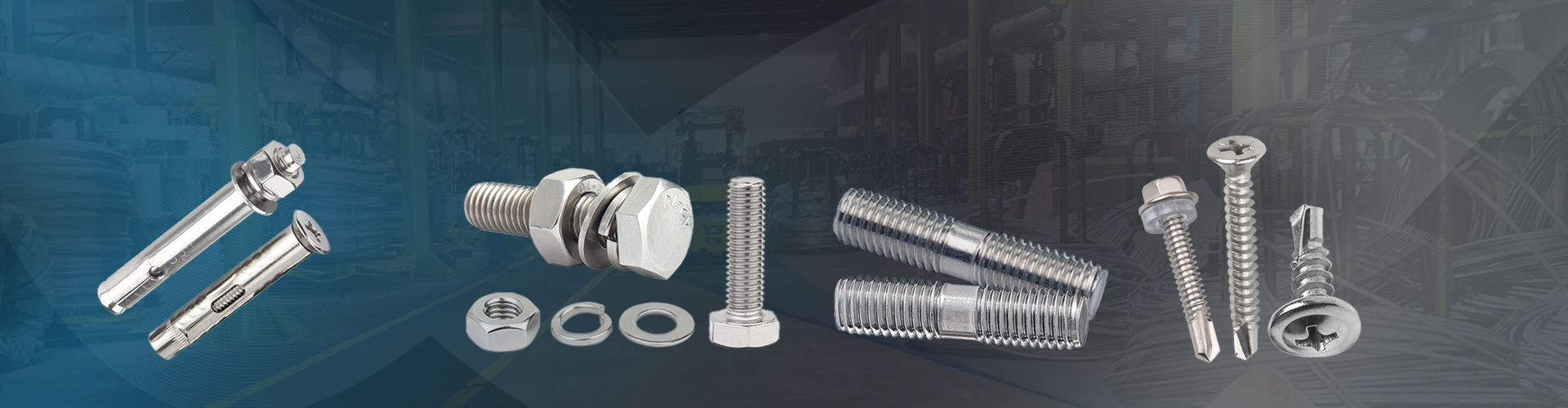
Hexagonal design: The head is a hexagonal groove, which needs to be installed with an hexagonal wrench, occupies little space, and is suitable for narrow environments.
Material and surface treatment: Stainless steel or alloy steel is mostly used, the surface is galvanized or passivated, and it has strong corrosion resistance.
2.Ordinary hexagon bolt
External hexagonal design: The head is an external hexagon, which needs to be matched with an open-end wrench or a socket tool, and a larger operating space is required during installation.
Strong versatility: low cost, but the rust resistance is usually weaker than 321 hexagon socket bolts.
3.Cross slot bolts (such as self-tapping screws)
Cross slot head design: suitable for quick installation of power tools, but limited load-bearing capacity and easy to slip.
4.Expansion bolts
Anchor structure: with expansion sleeve at the tail, used for wall or concrete fixing, but difficult to disassemble and cannot be reused.
2.Performance and strength comparison
|
Type |
Tensile strength (MPa) |
Shear strength |
Corrosion resistance |
Applicable loads |
|
321 hexagon socket bolt |
800-1000 |
High |
Excellent (stainless steel) |
Heavy loads, precision equipment |
|
Ordinary hexagon bolt |
400-600 |
Medium |
Fair |
Medium and low loads, general scenarios |
|
Cross slot bolt |
200-400 |
Low |
Poor |
Light loads, temporary fixation |
|
Expansion bolt |
500-700 (static load) |
Medium |
Fair |
Wall anchoring, static load-bearing |
3.Application scenarios and selection recommendations
1.321 hexagon socket bolts
Applicable scenarios: precision instruments, automobile engines, aerospace equipment and other fields with high space and strength requirements.
Advantages: high load, anti-loosening, high temperature/corrosion resistance.
2.Ordinary hexagon bolts
Applicable scenarios: furniture assembly, ordinary mechanical structure and other conventional needs.
Limitations: susceptible to environmental corrosion, long-term use requires regular maintenance.
3.Cross-slot bolts
Applicable scenarios: lightweight fixation of household appliances, plastic parts, etc.
Risk warning: easy to loosen in high vibration environment.
4.Expansion bolts
Applicable scenarios: static anchoring of building walls, pipe supports, etc.
Precautions: not suitable for dynamic load or frequent disassembly scenarios.
4.User FAQs
Q1: Can 321 hexagon socket bolts replace ordinary hexagon bolts?
Depending on the load requirements, 321 hexagon socket bolts are recommended for high-precision and high-strength scenarios.
Q2: How to avoid hexagon thread slippage?
Choose a matching wrench size, control the installation torque, and avoid over-tightening.
5. Summary
321 hexagon socket bolts excel in strength, durability, and compactness, and are particularly suitable for high-precision industrial scenarios; while ordinary hexagon bolts, cross-slot bolts, and expansion bolts have advantages in cost, convenience, and anchoring requirements, respectively. When selecting, it is necessary to combine specific working conditions, budgets, and maintenance costs to achieve the best match.

Bolts